
Business Panel: You Can Make Money — And The World A Better Place
By MIRANDA ZHANG
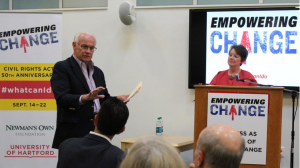
Bob Forrester, president and CEO of Newman’s Own Foundation, talks about social enterprise at a panel discussion at the University of Hartford Thursday. (Miranda Zhang)
Can a business make money and contribute to the community at the same time?
That was the core question panelists discussed at the University of Hartford Thursday night. With the nation observing the 50th anniversary of the Civil Rights Act of 1964, Newman’s Own Foundation sponsored the panel as part of its “Empowering Change” events in September.
When actor Paul Newman founded his food company, Newman’s Own, in 1982, many people didn’t think the model could work, said Bob Forrester, president and CEO of Newman’s Own Foundation, who was part of the panel.
“Now 33 years later, at the end of this year it will be $420 million that we’ve been able to donate,” Forrester said. “We have over 120 products. We compete in one of the toughest business I can think of — food business, the markets aren’t great. … We know for a fact that our consumer, part of our consumer, sticks with us because of our charitable, social responsibility profile.”
Forrester, a close friend and philanthropic adviser to actor Paul Newman, is a University of Hartford alumnus.
Also on the panel were Daphne Berry, assistant professor of management/marketing at the University of Hartford; Stephanie Capparell, an editor and writer at The Wall Street Journal; Kate Emery, founder and CEO of The Walker Group; and Sanford Cloud Jr., chairman and CEO of The Cloud Company, LLC. Elizabeth S. Gagne, vice president and chief administrative officer of business insurance for Travelers, Inc., hosted the panel.
Berry: Stakeholders Count
Berry teaches a course about social enterprise, broadly defined as a business organization that values stakeholders and not just shareholders, she said. Her class studies regular for-profit corporations and worker cooperatives, for-profit organizations where the workers own the business.
“It turns out that concept that corporate boards and all of the executives at corporations are only responsible to the shareholders is not quite accurate anyway,” she said. “But if everybody thinks that, then that becomes the truth.”
An organization does not necessarily have to be a charity to do the right thing, she said.
“You can be a benefit organization, you can be a worker cooperative, or you can be a worker or an owner of a regular business here and do the right thing.”
Capparell: The Pepsi Challenge
Capparell wrote “The Real Pepsi Challenge: How One Pioneering Company Broke Color Barriers in 1940s American Business,” which tells the story of Pepsi-Cola’s hiring of an all-African-American sales team to target black consumers as a distinct market.
“Why did this work so well at the time?” Capparell asked. “It was because before [World War II], I think, people were willing to accept some change, but after the War, America really was geared for change. Sales was a good place to start because sales was a little more even playing field.”
Walter Mack, former president of the Pepsi-Cola Co., wanted to become a rich man and do it the right way, Capparell said. The creative businessman made Pepsi the nation’s No. 2 cola drink.
“For an American company at that time to do what Walter Mack did was scary. They treated companies the same way they treated individuals. … He had a lot of other businesses that were joining him. A lot of businesses were not afraid of controversy at the time.”
Emery: Transforming To Social Enterprise
Emery established The Walker Group, a technology services firm, in Farmington in 1985.
“It was all about innovation as it always has been in technology,” Emery said. “There’s this hesitation to change not in technology, but in our way of doing business. And that’s crazy.”
In 2007, Emery restructured Walker to a social enterprise, where profit is distributed equally between employees, the community, and shareholders.
Social enterprise is powerful force for entrepreneurs to use the profits as a means to end, she said.
Cloud: Making A Difference
Cloud, chairman and CEO of The Cloud Co., LLC, a real estate development and business investment firm, said social enterprise was a new term for him.
“The term I know is corporate social responsibility,” he said.” So now I’m introduced to social enterprise and I’m really intrigued by that.
“And I think there are a lot of wonderful opportunities and new models. But it’s all about the same thing. It’s about how you make a difference and benefit the society not simply by the products or services that you provide, but also by engaging and understanding the importance of other stakeholders, the employees and the greater community.”