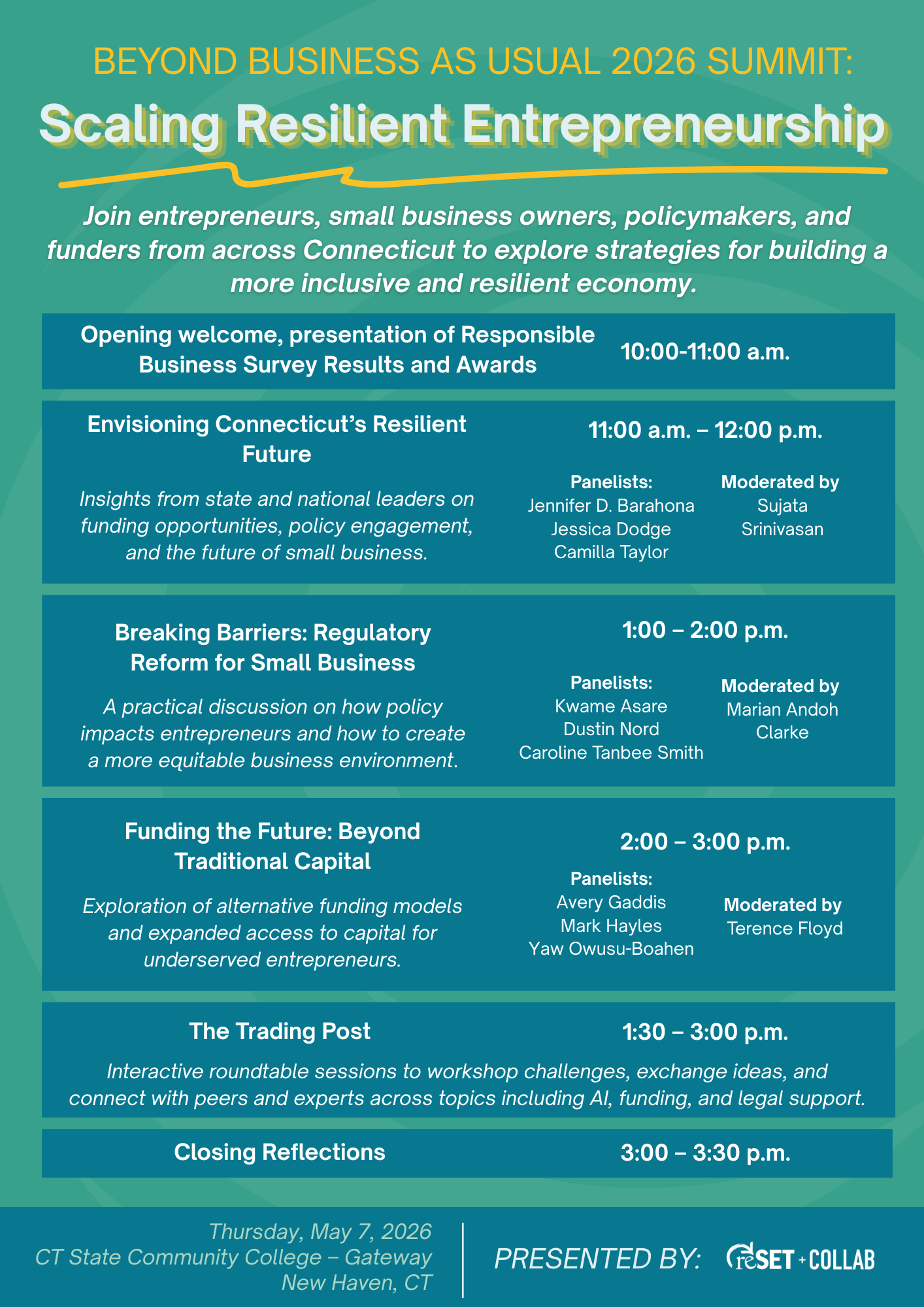

Recapping Beyond Business as Usual 2026: Scaling Resilient Entrepreneurship
A Day Full of Honest Connection for Entrepreneurs
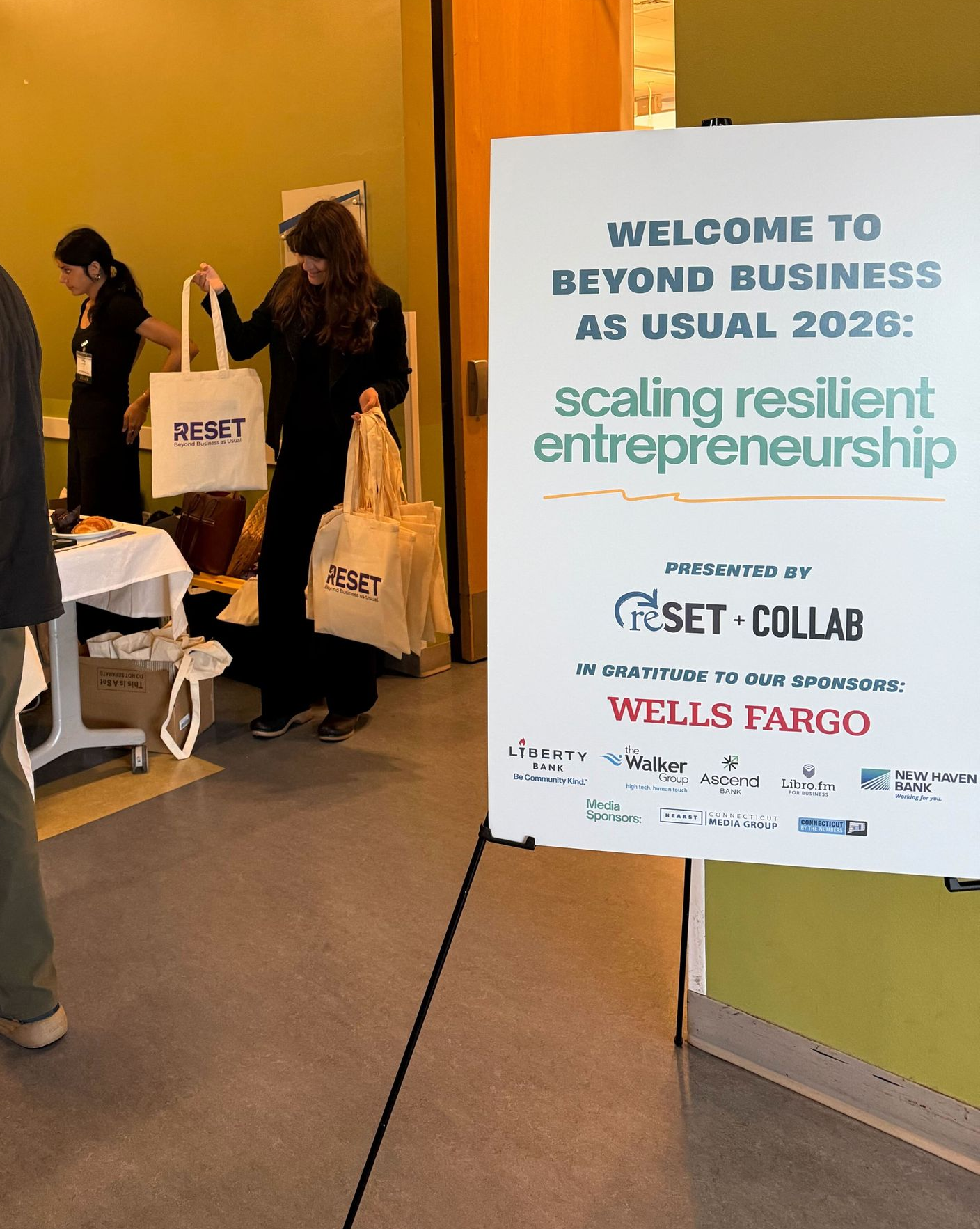
This year's Beyond Business As Usual leveled up with a day-long summit, with over 125 entrepreneurs, entrepreneur-curious students, policymakers, business support sectors, and members of entrepreneurial support organizations in attendance at CT State - Gateway. We heard from several attendees who felt the panelists were refreshingly honest about the challenges faced by entrepreneurs.
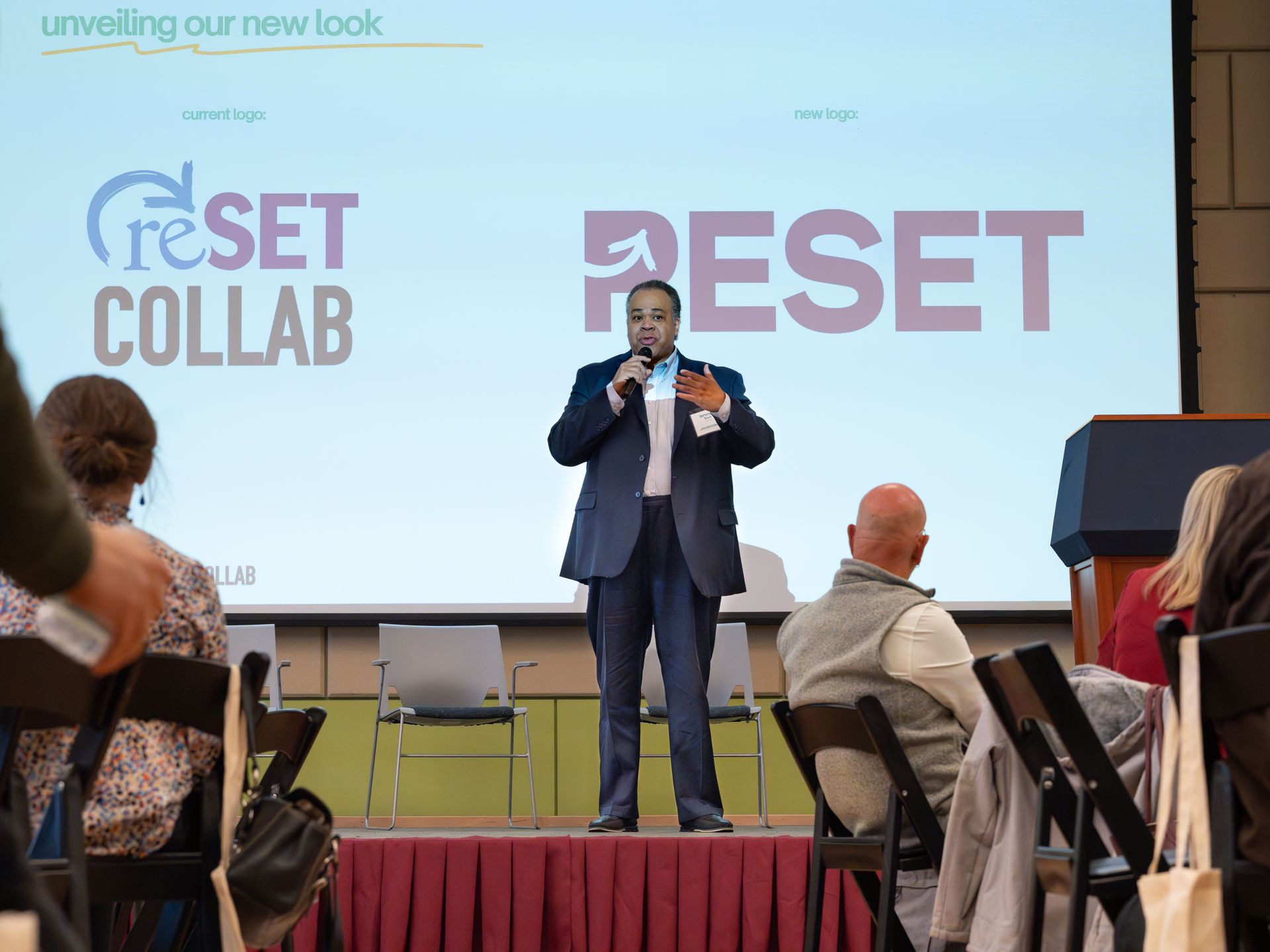
The program opened with remarks from reSET leaders Sarah Bodley and Dave Menard, who set the tone for a day centered on connection, resilience, and action—emphasizing that resilience depends not only on individual grit, but also on access to capital, strong networks, and systems that help businesses grow. The morning also included welcome remarks from Dr. Shiang-Kwei Wang of CT State Community College–Gateway and lead sponsor Terry Floyd of Wells Fargo Foundation.
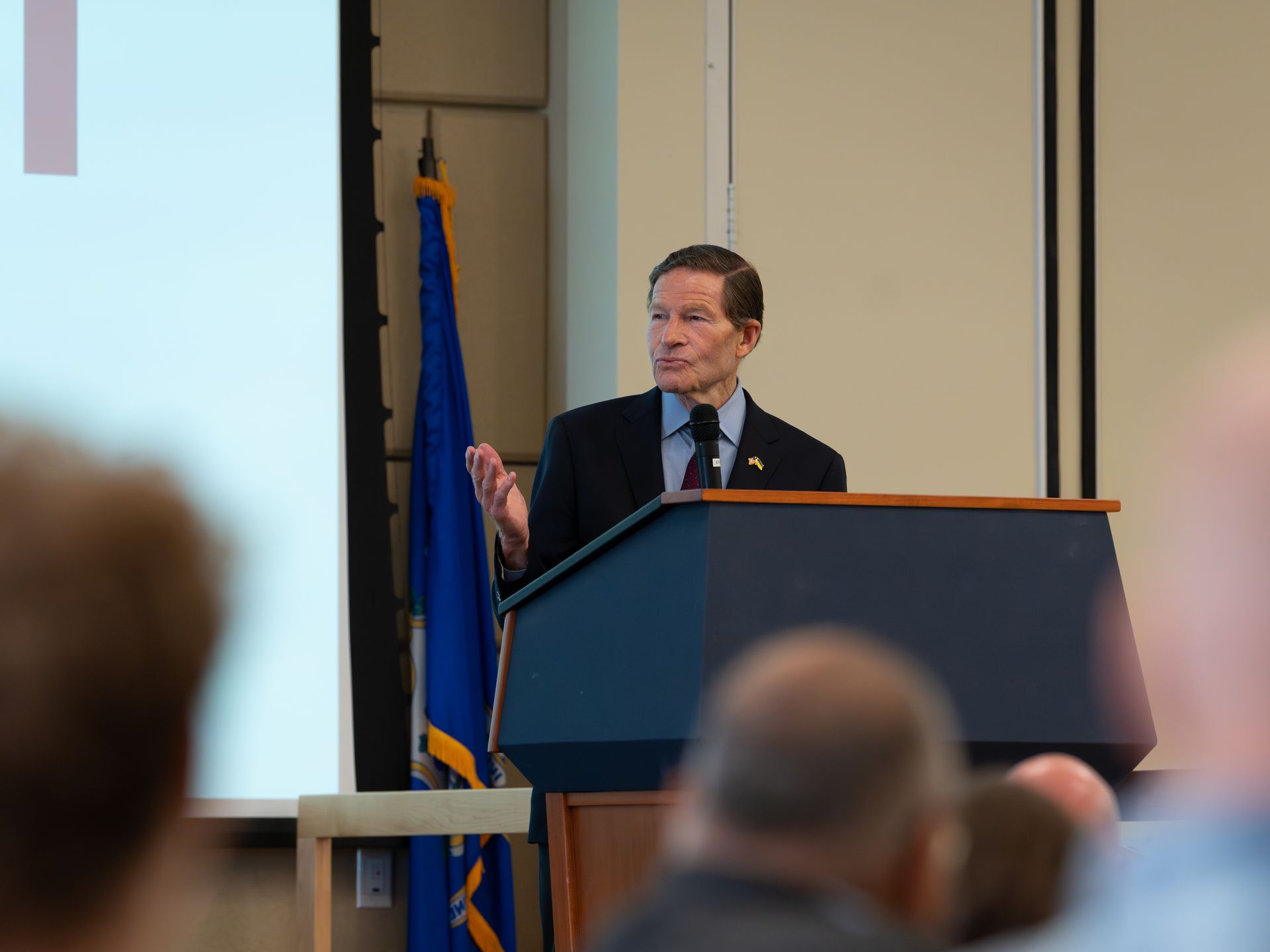
Senator Richard Blumenthal joined to welcome attendees, saying: "We can't afford the luxury of despair or disengagement. The role models that we're honoring today are really the people who count in this country, and they will continue to count. And for all of the young people who are coming up and looking for leaders, they're in this room. So thank you everyone for keeping faith, keeping alive the American Dream—which is doing good for others as well as for yourself by creating wealth and creating opportunity as you are doing literally every day."
Honoring Entrepreneurs
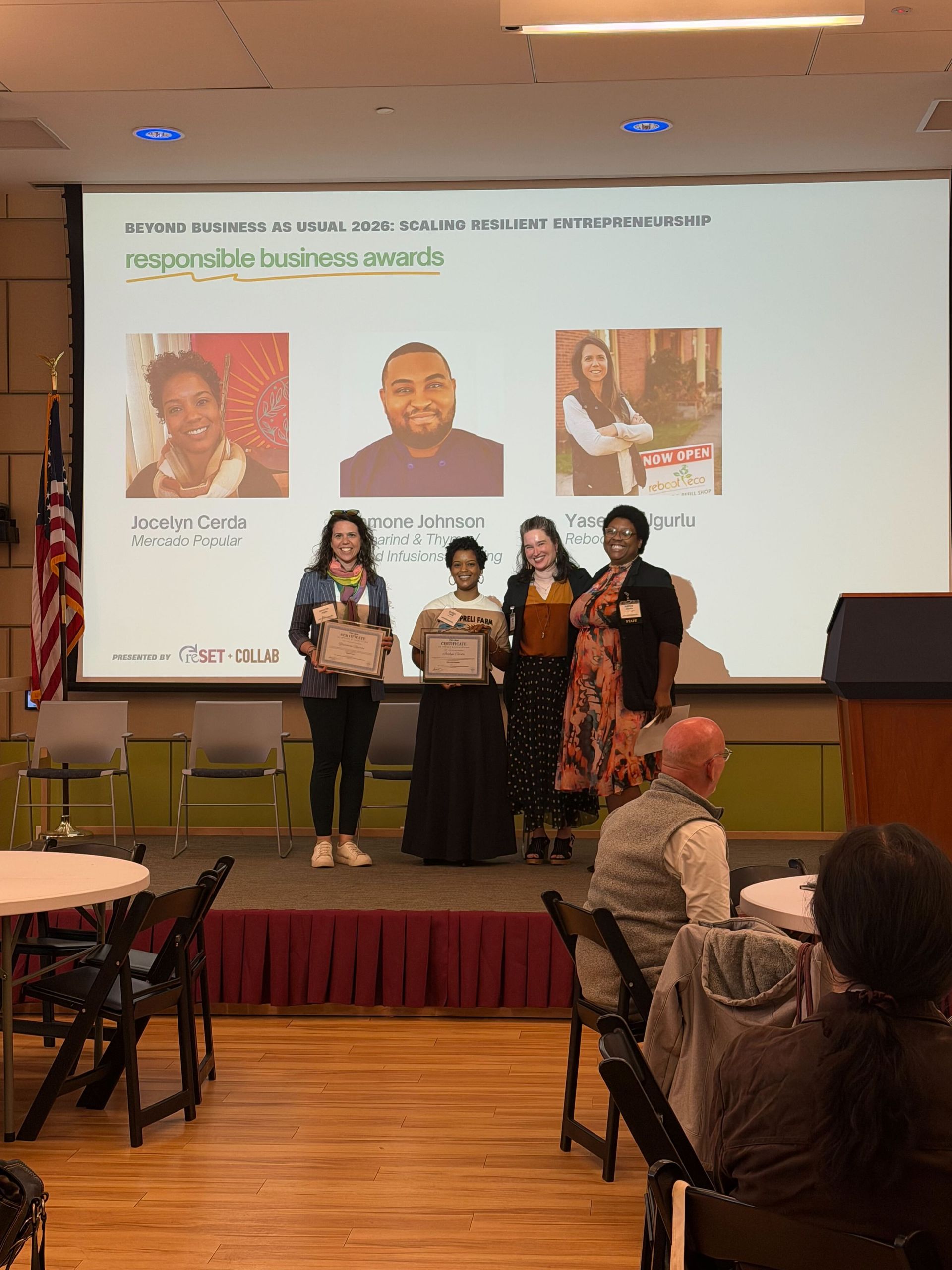
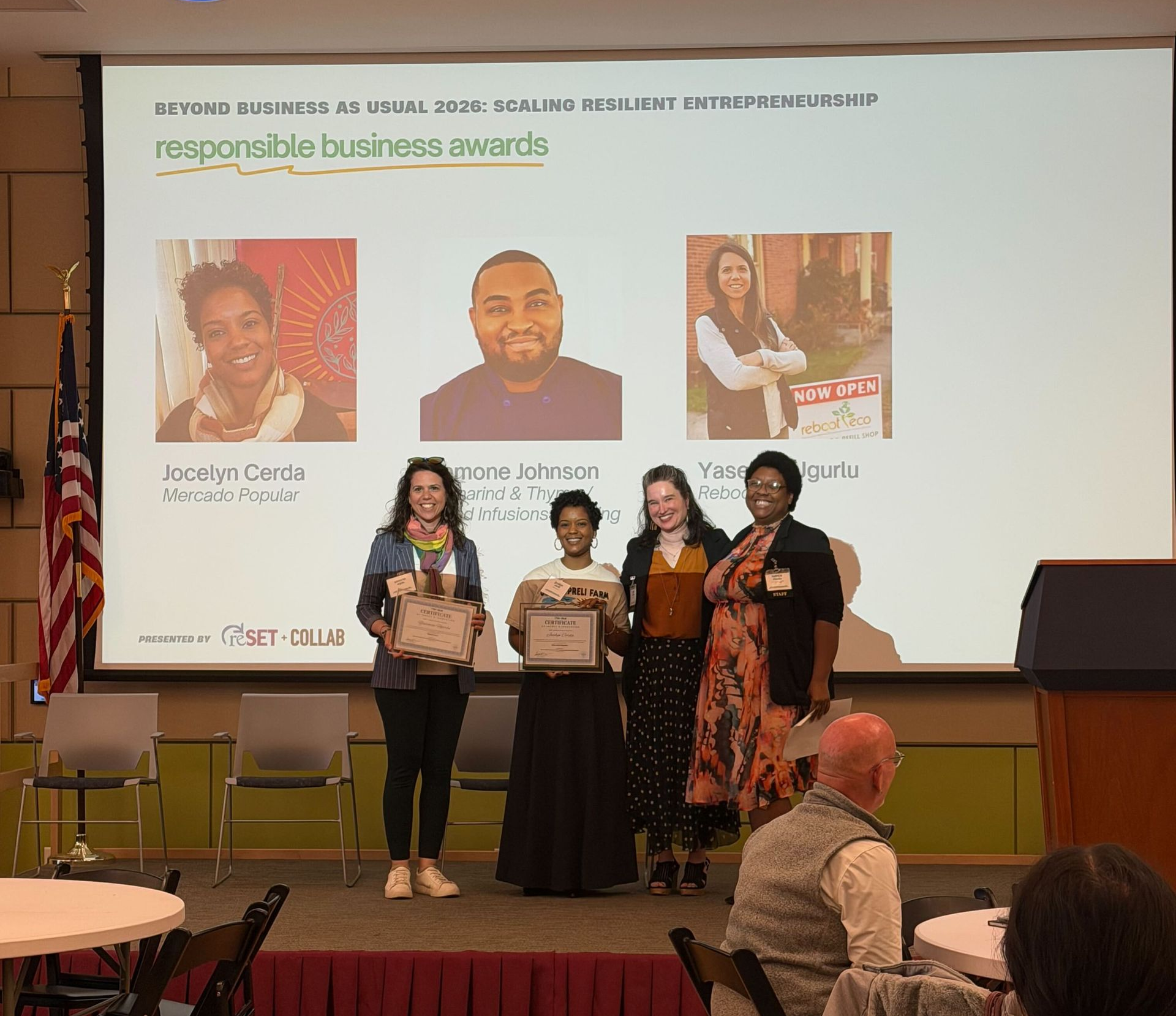
Reset then honored three entrepreneurs for their impactful leadership, receiving U.S. Senate Citations from Senator Blumenthal and Certificates of Impact & Innovation from Reset. The alumni companies were recognized for their outstanding work creating positive change through community engagement and cultural visibility.
- Jocelyn Cerda of Mercado Popular was recognized for making fresh, culturally relevant food more accessible in Hartford while supporting local farmers and advancing food justice.
- Damone Johnson of Tamarind & Thyme was honored for his Caribbean Fusion food truck and the "So We All Can Eat" pay-it-forward program.
- Yasemin Ugurlu of Reboot Eco was celebrated for building a refill shop that makes low-waste living feel practical and approachable.
Responsible Business Survey Results
Next up, Reset presented the findings from our recent Responsible Business Survey, produced in partnership with CT Sustainable Business Council, including an interactive audience survey on the challenges and opportunities facing responsible businesses. Click here to see a summary of what was shared.
Following the morning’s welcome, the day moved into a series of panels on policy, capital, and the future of Connecticut's entrepreneurial ecosystem, and a networking lunch catered by Sanctuary Kitchen. Guests also connected with our many entrepreneur support organization partners during the Expo and Trading Post.
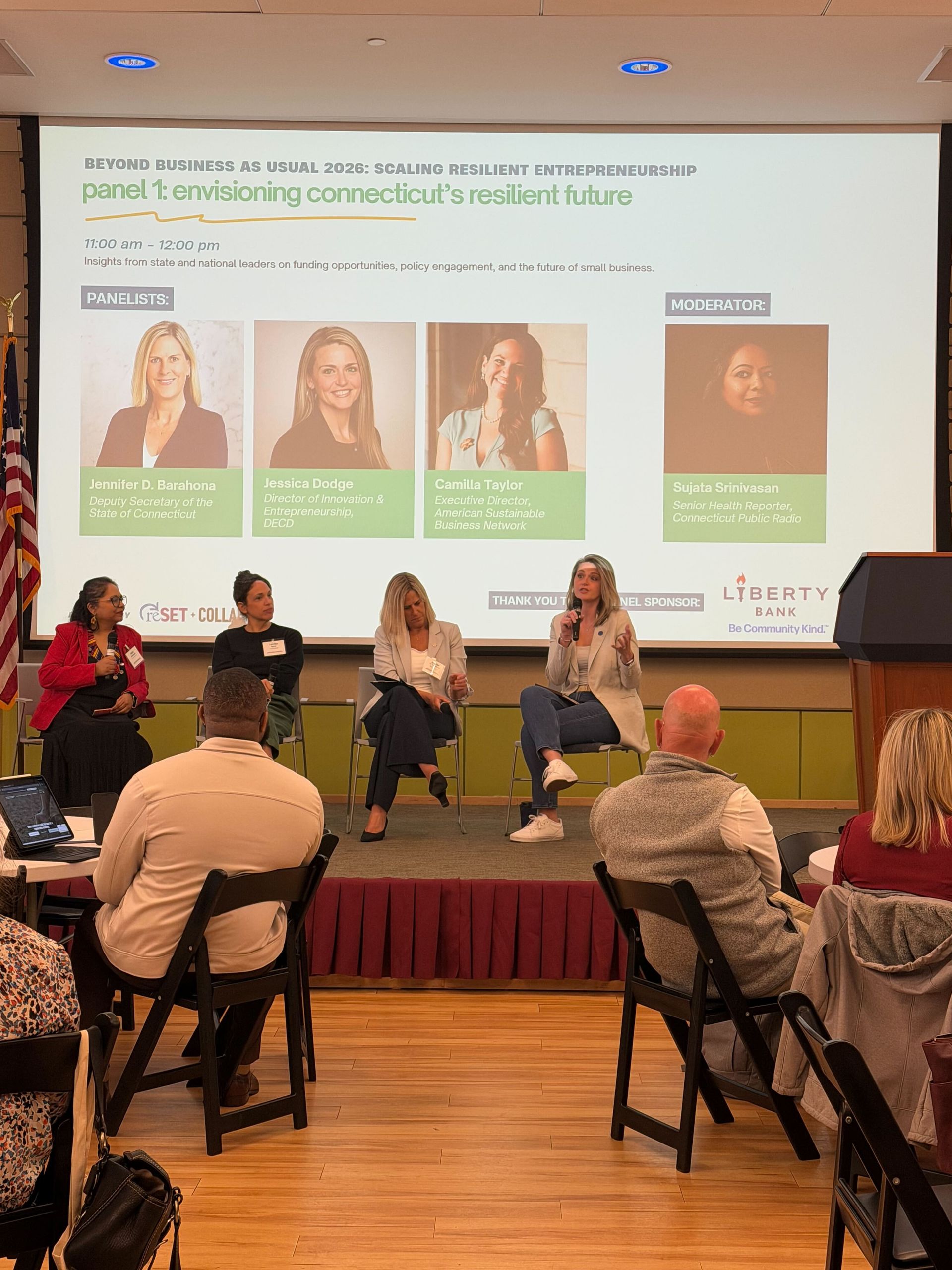
Panel 1: Envisioning Connecticut's Resilient Future
The opening panel, moderated by Sujata Srinivasan of WNPR Connecticut Public Radio framed entrepreneurship as a constant balance of grit, community, and long-term thinking. Camilla Taylor, Executive Director of the American Sustainable Business Network captured the daily reality entrepreneurs navigate: "You have payroll in two weeks or a month, and you are constantly toggling between those two realities in the decisions you make. You walk through your communities every day, you experience your impact—and so resilience is thinking with that short-term, immediate impact that you're living in, and also long-term thinking and how to move forward."
A major theme was civic voice. Jennifer Barahona, Deputy Secretary of the State of Connecticut pushed entrepreneurs to engage directly with elected officials: "No policy is created on election day. It is incumbent upon us to be engaging with our elected officials—whether it's town zoning, regulations, state, or federal—to tell those stories. I have my own examples where I had two legislators say 'it was your story that changed my mind on this issue.'"
Panelists also stressed that entrepreneurs don't have to navigate any of this alone.
Jessica Dodge, Director of Innovation and Entrepreneurship at CT DECD reminded attendees of the range of available resources, from the Secretary of State's business one-stop portal to state regulatory agencies, and closed with a simple but important message: "You don't know what you don't know. And by the way, you don't have to figure it out on your own."
The panel also touched on responsible innovation, urging entrepreneurs to approach AI carefully, protect customer data, and stay grounded in verified information as fraud and misinformation become more common.
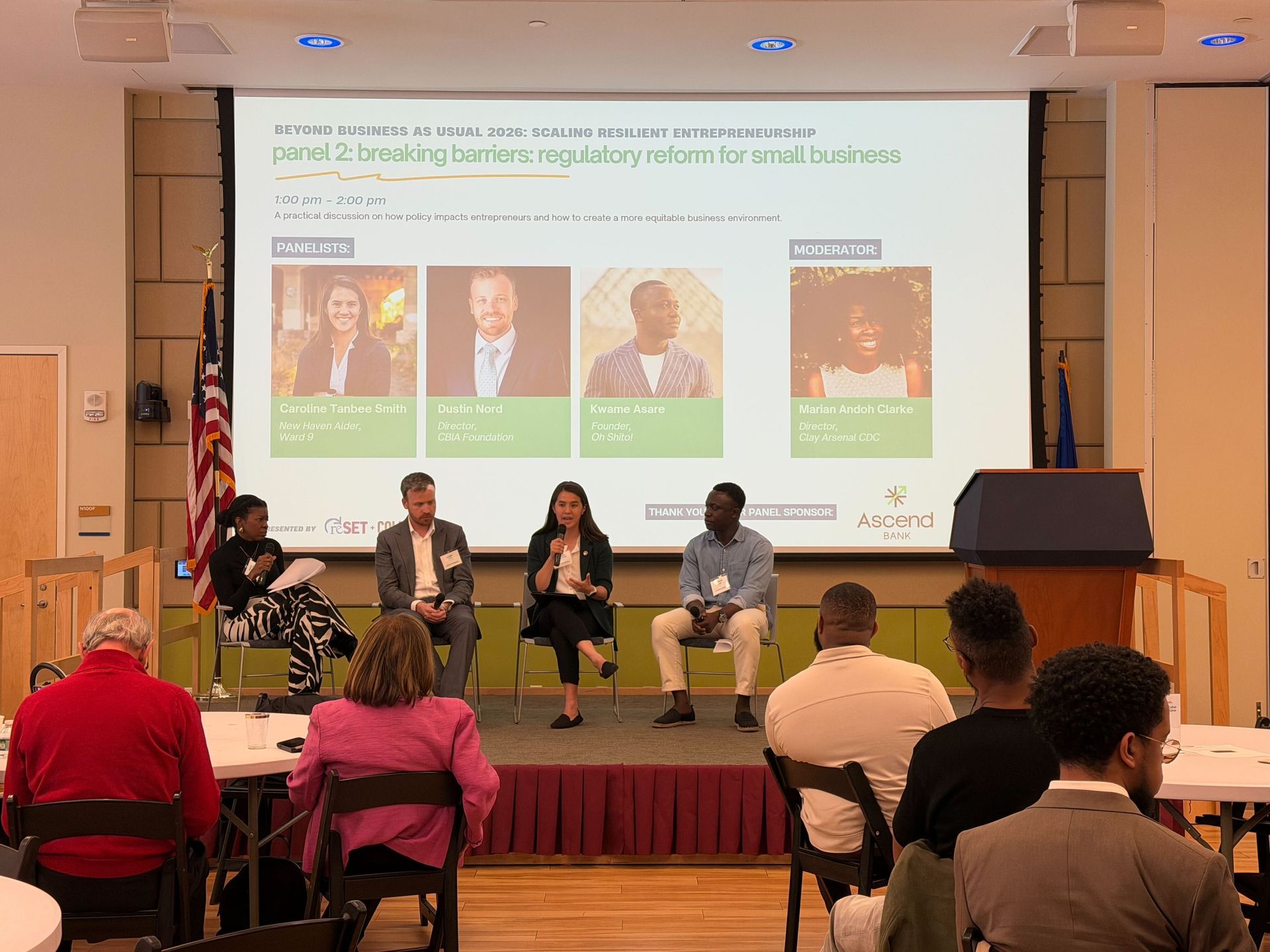
Panel 2: Breaking Barriers — Small Business Regulatory Reform
The second panel, facilitated by Marian Andoh Clarke, Director of Economic Mobility and Sustainable Business Development at the Clay Arsenal Community Development Corporation, made a strong case for entrepreneur-led advocacy, centering on how small businesses can—and must—help shape the policies that affect them.
Dustin Nord, Director of the CBIA Foundation was direct about why that input matters: "Hearing from small businesses is the only way we find out the actual, meaningful impacts of new policies. It's the intricacies and the details we hear from individual businesses that help guide the decisions we make."
Caroline Tanbee Smith, New Haven Ward 9 Alder reminded entrepreneurs of the unique trust they carry: "Small businesses are some of the most trusted institutions in the country because they're part of our daily lives. In this moment where there's been erosion in trust in institutions, it is incredibly powerful for a policymaker or decision maker to hear directly from you and how you will be affected."
Kwame Asare, founder of Oh Shito! encouraged entrepreneurs not to underestimate their own voice: "When you're an entrepreneur, you might feel like your concerns are minimal or don't help on a grander scale, but being strong enough to voice your opinion and connect with other entrepreneurs going through the same issues will help us all feel more empowered to speak up—which will eventually expand to a bigger solution or policy change."
The panel returned repeatedly to specificity as the key to effective advocacy. As Nord explained: "Clearly defining the thing that is a challenge for you is one of the hardest parts of advocacy, but also probably the most important—it's the very specific things that get people motivated and moving in the same direction." Marion Clarke put it plainly: "You have to be a squeaky wheel."
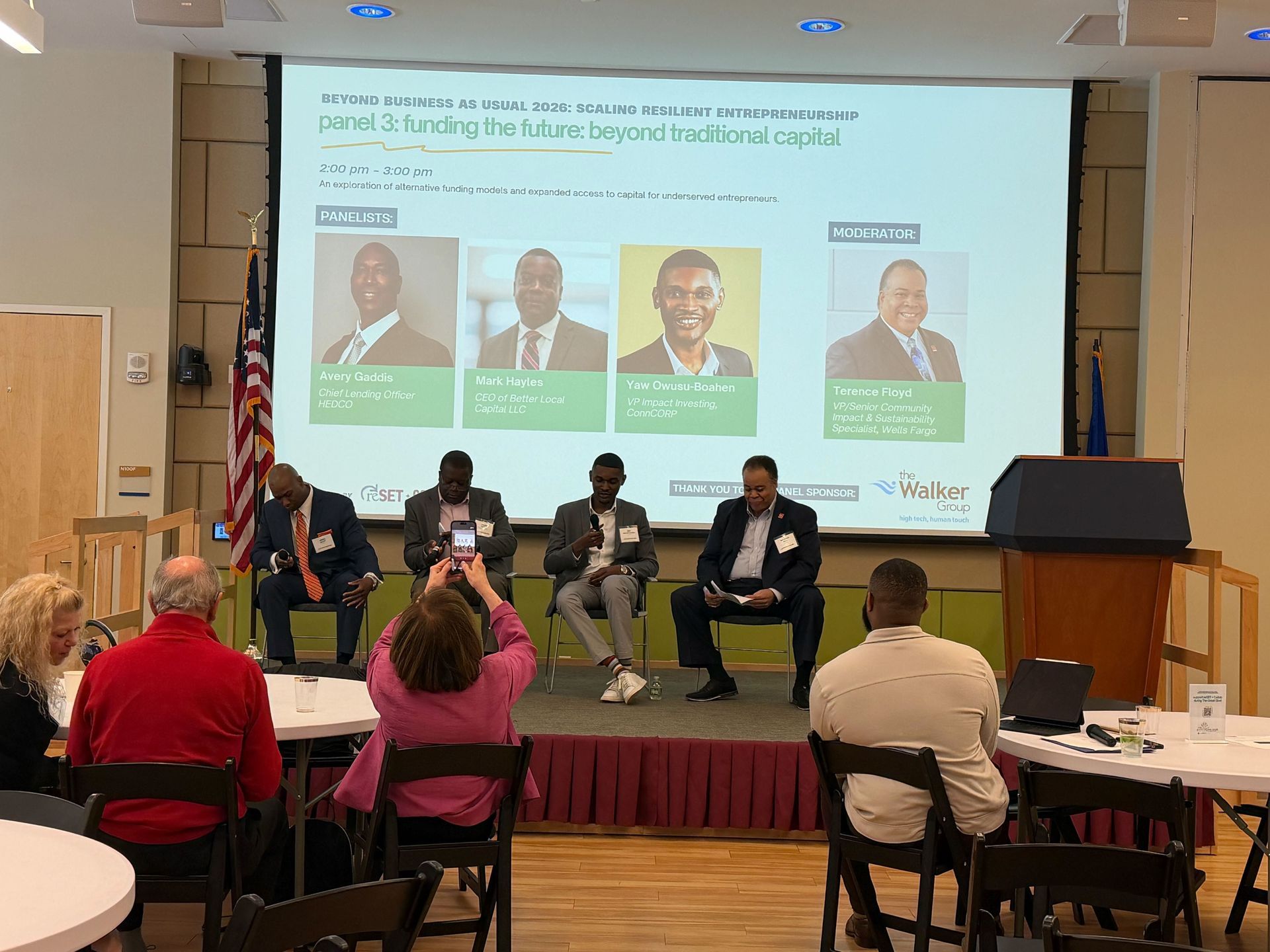
Panel 3: Funding the Future — Beyond Traditional Capital
The third panel tackled one of the most persistent barriers for small businesses: access to capital. Yaw Owusu-Boahen, Vice President of Impact Investing, ConnCORP named the systemic reality directly: "The core problem is that the system wasn't necessarily built with underrepresented or minority entrepreneurs in mind. It was designed with a different type of entrepreneur in mind, and now what we're trying to do is take a system that was designed for certain people and expand access to everyone."
He also challenged the broader narrative around entrepreneurship itself: "I'd actually love to see fewer people starting businesses out of necessity. I want to see more people starting businesses out of opportunity—because they saw a market need and felt like they had the resources to deliver against it."
Mark Hayles, CEO, Better Local Capital called on lenders to meet businesses where they actually are: "Waiting to be funded 30, 60, or 90 days is not helpful for a construction company that needs to mobilize in three weeks' time. So be smarter, be fairer, be faster—those are the fundamental drivers for us."
Avery Gaddis, Chief Lending Officer, HEDCO offered a sharp note on what lenders are looking for when entrepreneurs walk in the door: "I like passion, I do. It's cute. But focus? Focus pays the bills,” adding, “If I determine in a two minute conversation that you're scattered about, you will get $0 so if you ask me, I will tell you the biggest asset you have when you come to see someone like me is laser-like focus, because you could only be the master of one, and not the Jack of all trades. That just doesn't work.”
The panel ended with an audience question probing short-term and long-term incremental changes worth exploring. Facilitator Terry Floyd, Vice President, Community Relations at Wells Fargo noted tax reforms to better align federal and state guidelines with the realities of small business needs. Yaw Owusu-Boahen highlighted community lending pools from his youth in Ghana. Mark Hayles spoke to partnerships between nonprofits and lending institutions as a way of creatively strengthening the system. Avery Gaddis closed with observations on predatory lending practices requiring much better regulation, and on a theme of the day – cost of living and affordability.
Looking Ahead
Throughout the day, one message came through clearly: resilience is not just about individual determination. It is also about knowing when to ask for help, using your voice to influence policy, and building financial systems that work for more entrepreneurs. BBAU featured conversations that were direct, practical, and grounded in the realities of running a business—exactly the kind of honest dialogue that helps move entrepreneurship forward and with impact.
We are immensely grateful to the Steering Committee members who made Beyond Business As Usual possible! Ming Hui, Daniella Henry, Heather Burns, Tara Spain, Jenn T. Grace, Ali Lazowski, Guilaine Menefee, Laura Dinan Haber, along with the reSET team, board, and many partners who supported throughout the day!
# # #