
Social Entrepreneurship: More Important Now Than Ever

Susan Coleman • July 16, 2020

Social entrepreneurship has been around, in one form or another, for decades if not longer.  As an example, one of our country’s early social entrepreneurs, Reverend Edgar J. Helms, launched what has become Goodwill Industries in 1902 to provide both jobs and affordable clothes to people who needed both.  Going back even further and prior to the Civil War,  our own Prudence Crandall opened a boarding school for girls and young women of color who wanted to be teachers, the first such establishment in New England. At the time, no one called these people “social entrepreneurs” and, in fact, that term didn’t really come into use until the 1980s when Bill Drayton, a social entrepreneur himself, founded Ashoka, an organization dedicated to finding and supporting social entrepreneurs.  Ashoka Fellows as they are called (3,500 from 92 countries) are entrepreneurs who have tackled some of the world’s most pressing social, cultural, and environmental challenges including poverty, hunger, health, education, human rights, and violence, to name a few.

What are some of the big challenges we are facing now?   COVID-19 has ushered in a broad array, including unemployment and lockdowns accompanied by food, housing, and financial insecurity.  In spite of the valiant efforts of our health care workers, our health care system seems broken and unable to cope with this crisis.  Schools have been closed, resulting in uneven access between communities and even within communities. Our people and our communities are suffering economically, socially, and spiritually.  As the song from the Broadway play “Hamilton” puts it “The World’s Turned Upside Down”; and it has.  Which is why social entrepreneurship is particularly well suited to the challenges of our time.

Social entrepreneurs go after problems that are too big, too complex, and too far-reaching for individuals, communities, businesses, or government to fix on their own.  Social entrepreneurs are innovators, capable of thinking outside of the box to design novel solutions for seemingly intractable problems.  We need that now, because our world has changed in so many ways that we never imagined.

The other reason we need social entrepreneurs is because, within the framework of social entrepreneurship, the emphasis is on social.  It’s about taking care of each other and working together to achieve common goals.  It’s about resolving our differences so, together, we can make our communities and our world a better place.  At this point in time, it’s about healing the wounds inflicted by the pandemic and a legacy of racism and discrimination. We need that now.

Social entrepreneurs are, by nature, action-oriented optimists.  They believe that big problems can be solved and, better yet, they believe that they can figure out the means for solving them.  They believe in a better and brighter future, and they are willing to take personal responsibility for helping to bring that about.  They’re changemakers, and accept the risks that come with that role, and they are passionate about the causes they pursue.  We need that now.

Each year reSET “graduates” a new cohort of social entrepreneurs from its accelerator program.  They are in our communities now, working to achieve positive change and make a difference.  Social entrepreneurs like these are an essential part of our entrepreneurial ecosystem, and they will help carry us through these extraordinarily hard times by addressing the challenges of today and the promise of tomorrow.  By nature, social entrepreneurs are a stubborn breed, so they will hold fast to the belief that the “new normal” has to be better than the “old normal”, and that it has to be better for more people.  They will find ways to bring us together to make it happen, and they will call forth the best in us.  We need that now.

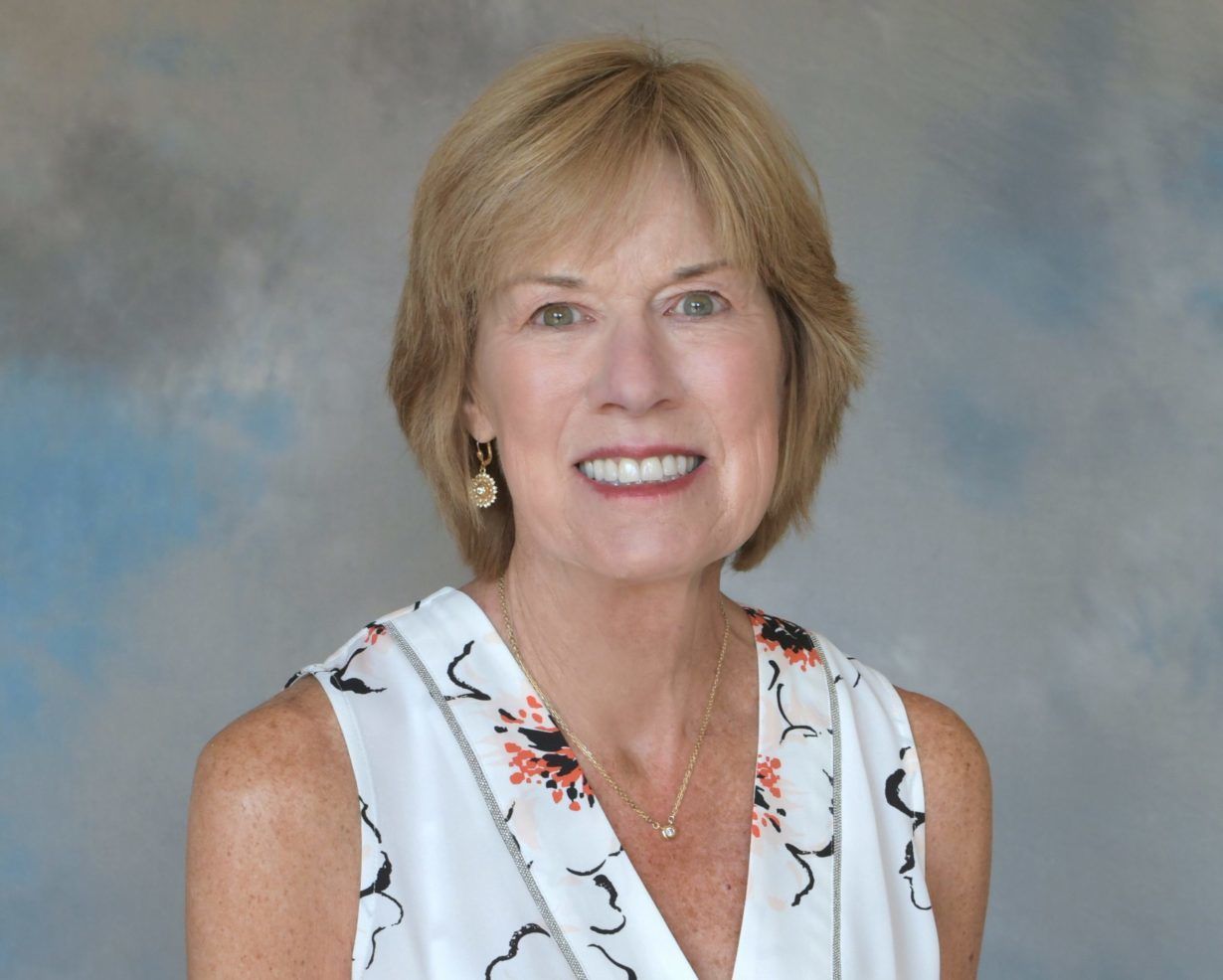
Susan Coleman is a reSET Board Member and Professor of Finance at the University of Hartford, where she teaches courses in entrepreneurial and corporate finance. Susan is also a co-author of three books, one on social entrepreneurship titled Creating the Social Venture. She previously served as a member of Governor M. Jodi Rell’s Economic Advisory Council.


By awalsh • September 29, 2026
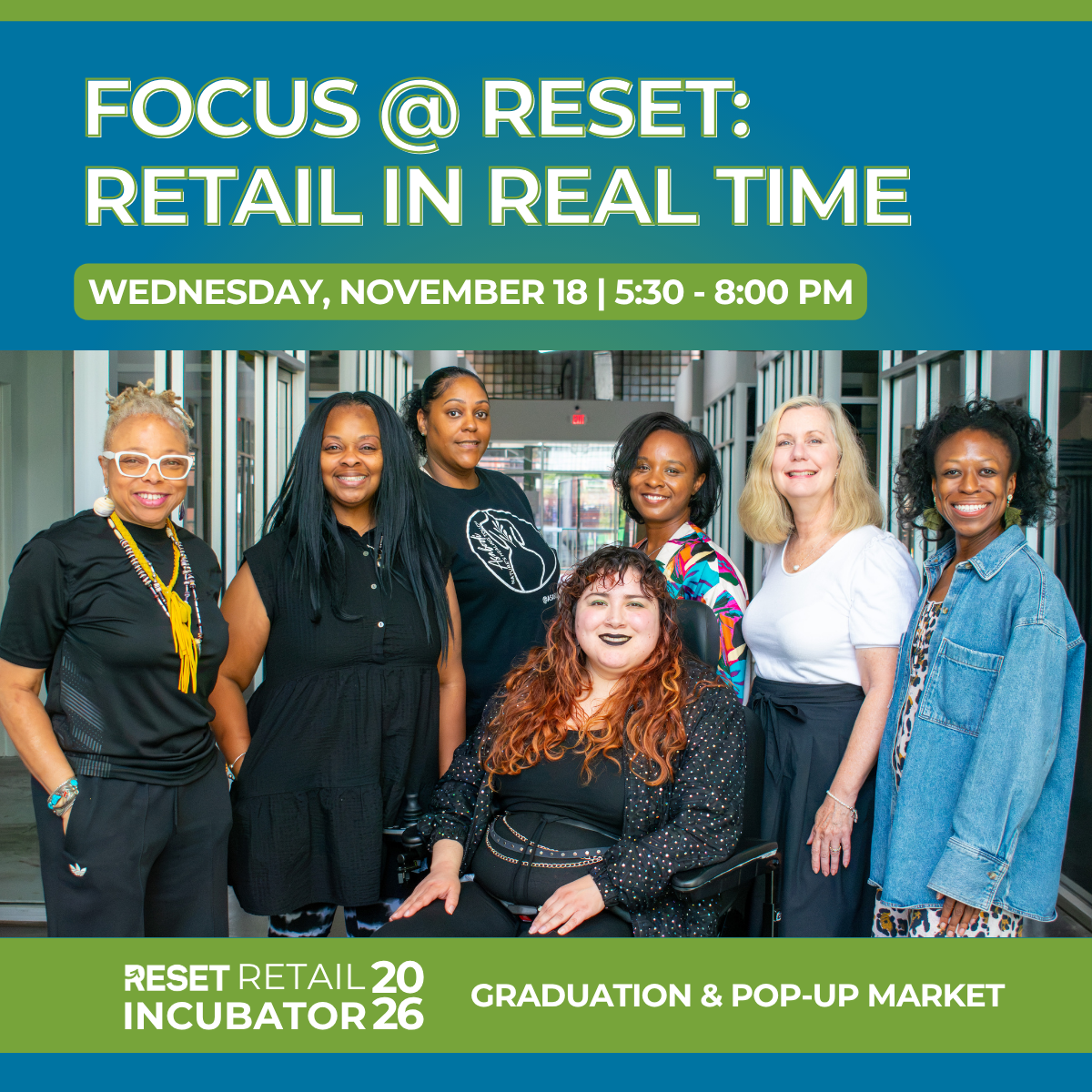
Program Supports Early-Stage Retail Businesses with $7,000 in Grants Hartford, CT – Tuesday, September 29, 2026 – Reset, the Connecticut-based entrepreneurial support organization committed to advancing impact-driven businesses, is proud to introduce the ten businesses participating in the sixth cohort of the Floor–Plan Retail Incubator this fall. The program equips local founders with the tools to launch, grow, and thrive in today's retail landscape. Thanks to support from the Connecticut Department of Economic and Community Development, each business completing the program will receive a $700 grant to support their business. Save the date: Focus @ Reset: Retail in Real Time The Incubator will culminate in the Focus @ Reset: Retail in Real Time graduation and pop-up market event on Wednesday, November 18 from 5:30-8:00pm at Southern Connecticut State University in New Haven, where the community can meet these entrepreneurs and experience their products firsthand. Get tickets at https://bit.ly/retail26 with the early bird discount of $5 off tickets purchased before November 1. "This cohort is building businesses that infuse care, heritage, and artistry into every product they make, and we’re excited to develop strong local businesses that invest right back into our communities," said Sarah Blecher, Executive Director of Reset. "This group brings the total number of retail businesses supported through the Retail Incubator to 73 since its launch in 2021." "From Puerto Rican pastries to block prints about collective liberation, this cohort shows how many different paths lead to a meaningful retail business," said Ndubisi Okeke, Reset Program Manager. "Our Retail Incubator gets them ready for holiday sales and sustainable operations well beyond this season, building businesses with impact." Comprehensive Support for Connecticut Entrepreneurs The Retail Incubator reflects Reset's commitment to supporting entrepreneurs who are building businesses that create positive community impact. During the 12-week program, participants access experienced mentors, legal and financial support, peer networks, and real-world opportunities to test and refine their business models. The $700 small business grant at the conclusion of the incubator provides additional support to grow their businesses. The Ten Businesses in This Year's Floor–Plan Retail Incubator: Assiah Tea & Wellness , founded by Margo Jones, offers premium loose-leaf teas, handcrafted herbal blends, and curated tea services, combining hospitality, education, and wellness to encourage connection and intentional self-care. Asabodi, created by Melissa Carrasco, is a growing small business offering vegan and plant based skincare products like turmeric sugar scrub, body butters, lotions, African black liquid soap, and scalp stimulator. Dream Fleurs , founded by accessory and web designer Maureen Connelly, is a lifestyle accessory brand inspired by flowers, travel, and historic gardens around the world. Granny's Doggie Treats , is a growing small business created by Claudia Cupe, specializing in quality, homemade dog and cat treats crafted to provide pet parents with wholesome, flavorful options while promoting responsible pet care and supporting the special bond between pets and their families. L&M Desserts , led by owner and head baker Anaïs Esther Nuñez, is a family-operated business bringing authentic Puerto Rican desserts to families, events, and catering clients across Connecticut. NUR the Label , founded by Yasmin Laila, is a contemporary fashion brand reimagining the kaftan through a modern lens, honoring African and Middle Eastern dress traditions with pieces designed for celebrations and everyday expression. Pajareando Press , created by artist, educator, and community organizer Elida Paiz Pineda, creates one-of-a-kind block prints, illustrations, and craft works exploring social justice, collective liberation, and radical joy. Ruby Sampson , founded by Ashley Powdar in 2016 in honor of her grandmother, is an artisan-powered brand based in the U.S. and Guyana that creates silk-lined hair accessories, head wraps, and apparel on a mission to close the grooming gap for natural hair textures. Trinkky Trinkks , founded by performer and choreographer Cristal Coleman, is a specialty gift boutique offering handcrafted jewelry alongside curated handbags, accessories, and unexpected finds, built as a pathway toward generational wealth. Wábi Arts , founded by photographer and arts advocate Kim Weston, is a developing gallery and teaching space in downtown New Haven featuring Connecticut-based and emerging artists and home to the FOCUS Fellowship, a teen photography mentorship program. About the Floor–Plan Retail Incubator Now in its sixth year, it is part of a suite of retail opportunities from Reset and Hartford-based Breakfast Lunch & Dinner, a community activation studio. Reset’s three-month incubator provides entrepreneurial technical support to early-stage retail businesses, helping participants understand customer needs, define pricing strategies, address key legal and financial topics, and prepare for new market opportunities. Entrepreneurs gain insights from industry experts, access a supportive community, and receive practical tools to enhance their business acumen. Through the Floor–Plan partnership, entrepreneurs can access additional market outlets and retail opportunities through Breakfast, Lunch & Dinner. About Reset Founded in 2007, Reset is a nonprofit organization headquartered in Hartford, CT, whose mission is advancing the social enterprise sector and providing inclusive entrepreneurial support across Connecticut. In February 2025, Reset acquired New Haven-based Collab, combining complementary strengths to create a more robust ecosystem for impact-driven entrepreneurs throughout the region. Reset specializes in social enterprise, meaning impact-driven businesses with double or triple bottom lines, and provides coworking space, accelerator programs, and mentoring services that inspire innovation and community collaboration. To date, Reset and Collab have assisted over 700 small businesses to start and grow with impact, and reached thousands more through low-touch supports. Visit resetco.org to learn more. # # #
By awalsh • July 9, 2026
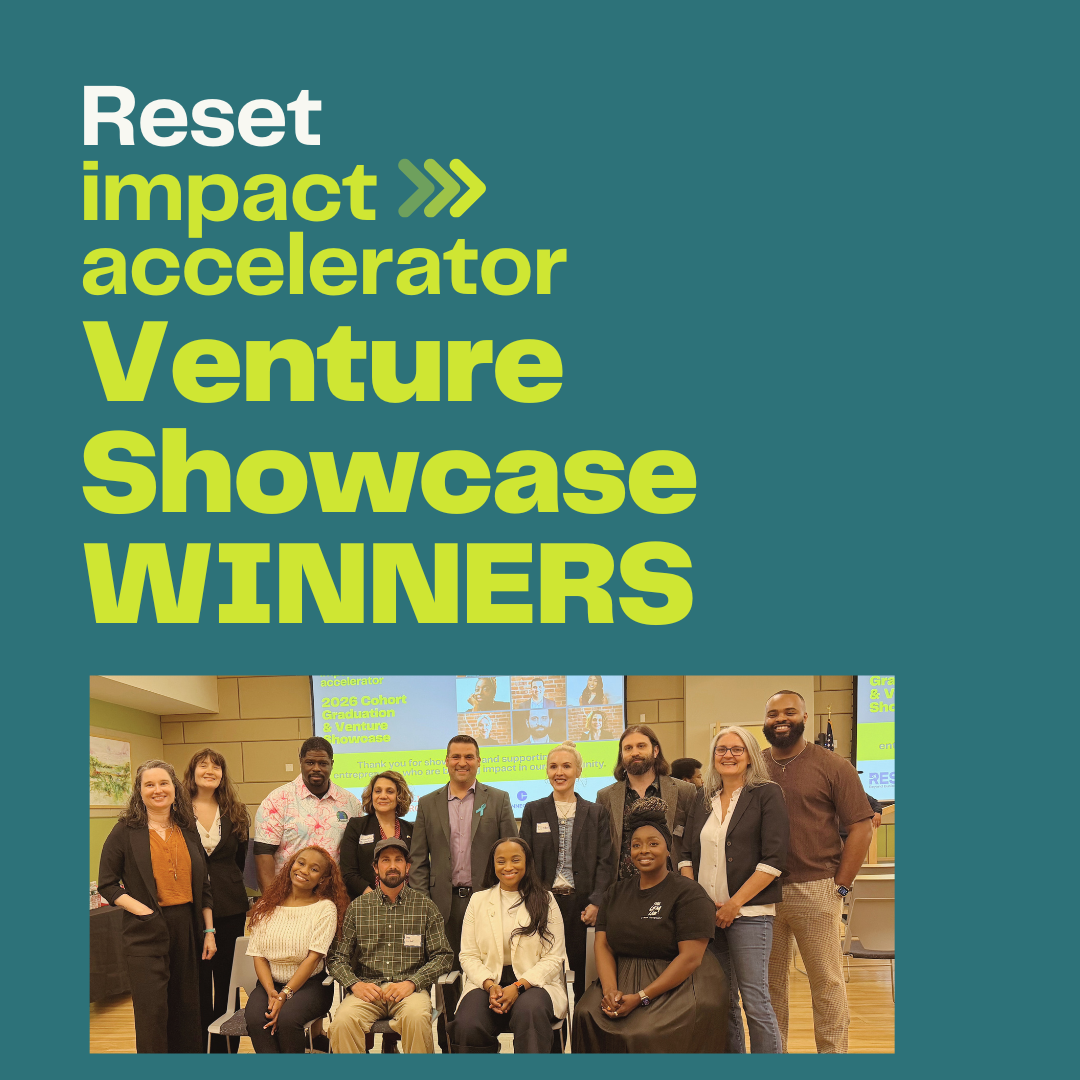
Showcase Awards Over $18,000 in Grants and Prizes
By awalsh • June 26, 2026
Nine Entrepreneurs Celebrate Graduation from Spring Cohort and Share Over $15,000 in Prizes and Grant Support
June 25, 2026
Launching a New Statewide Partnership to Connect Aspiring and Growing Food Businesses with Structured Programming, Education & Resources
Sarahblecher
June 23, 2026
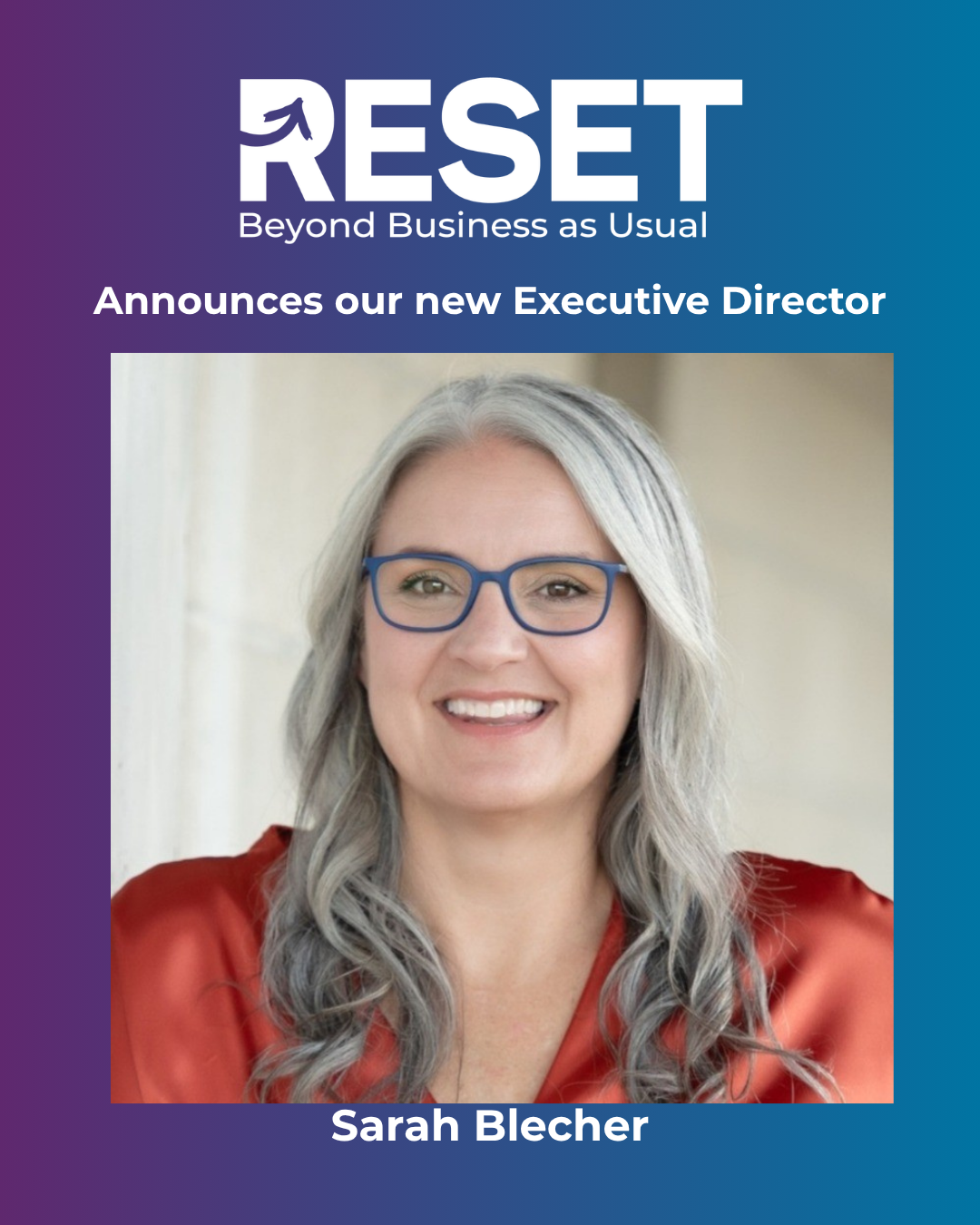
Marketing Strategist and Connecticut Small Business Mentor Succeeds Sarah Bodley
By awalsh • June 4, 2026
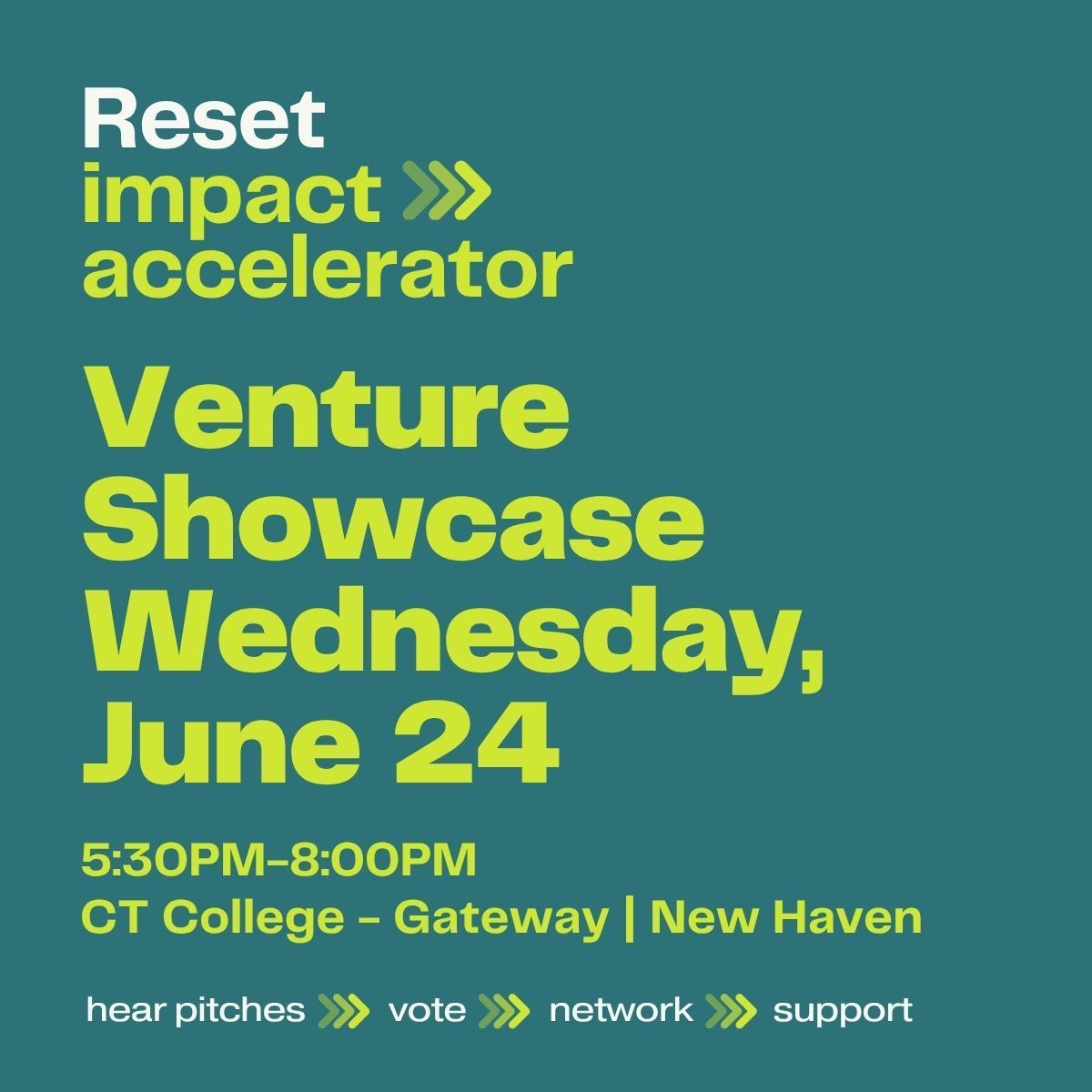
Eight Businesses Will Compete for Over $15,000 in Prizes and Grant Support at CT State Community College–Gateway
May 14, 2026
Reset announces its new logo
May 14, 2026
A Day Full of Honest Connection for Entrepreneurs
By SBodley • May 7, 2026
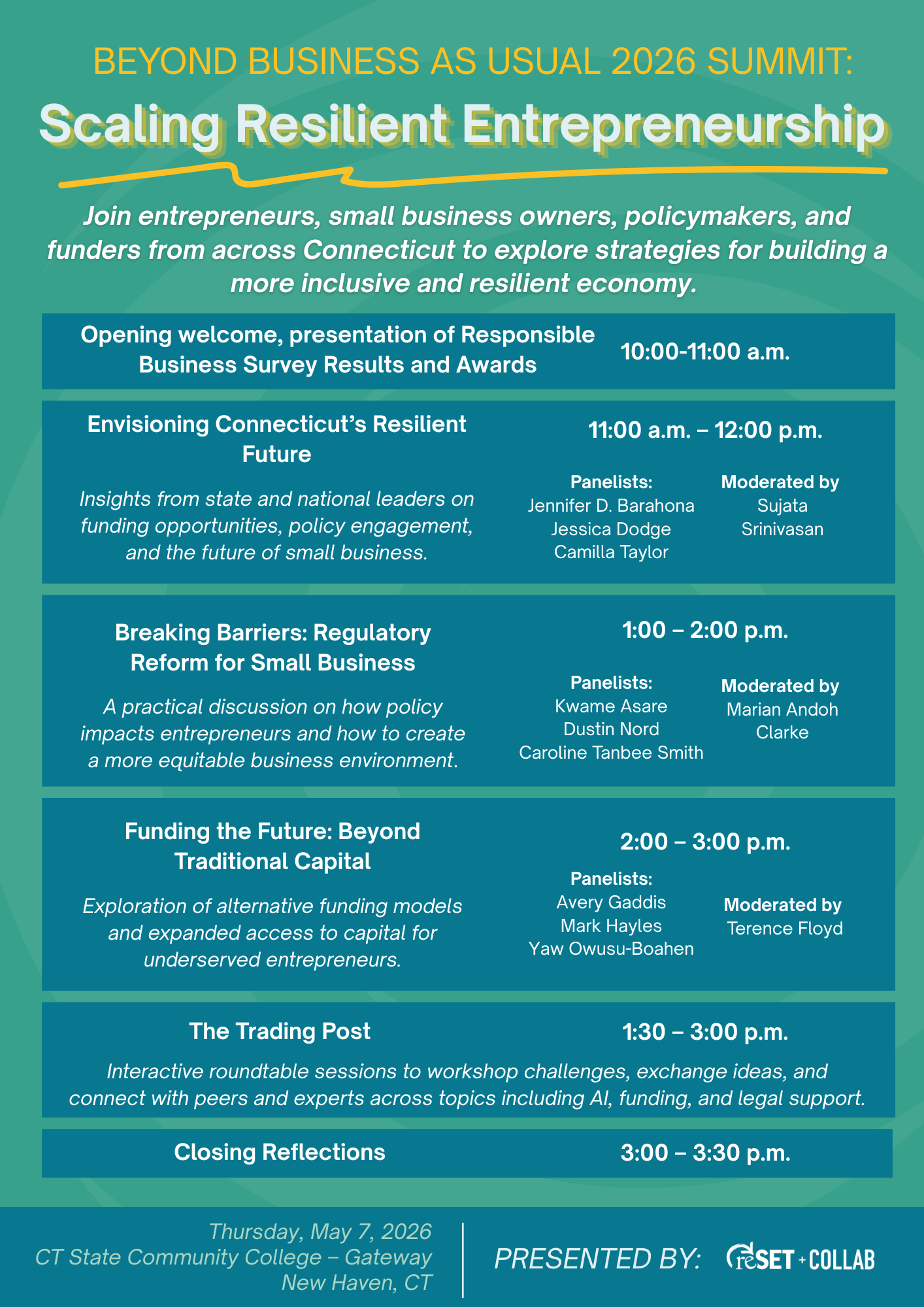
This Spring we asked our community to weigh in on their biggest challenges, interests, and opportunities related to impact-driven and sustainable business. We were proud to partner with CT Sustainable Business Council on this effort. Select findings were shared at Beyond Business As Usual 2026: Scaling Resilient Entrepreneurship, and we aim to continue taking action on the things that rose to the top. Click through the arrows to see the key findings.
By awalsh • April 23, 2026
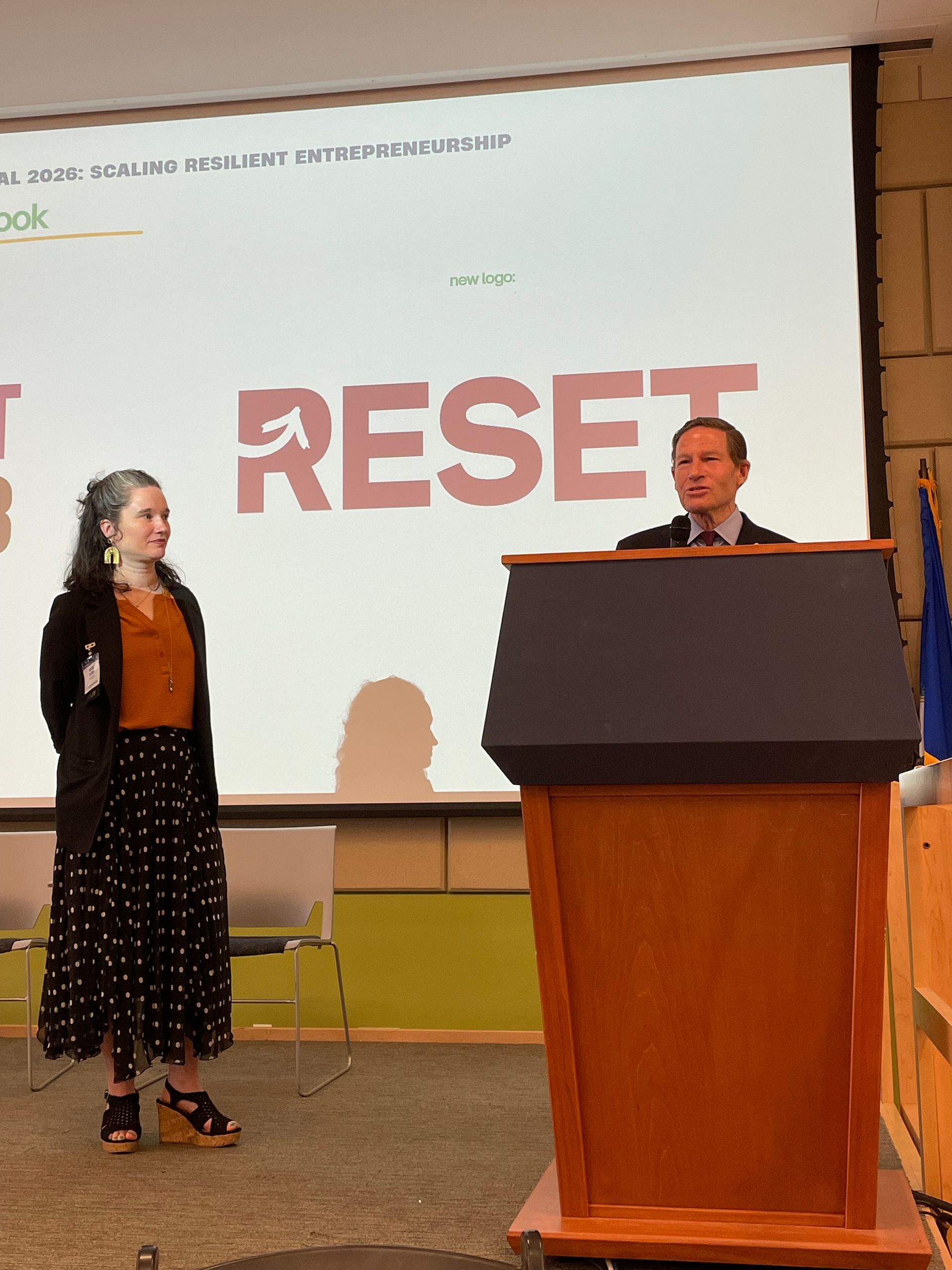
 Summit Brings Together State Leaders, Policymakers, and Entrepreneurs During National Small Business Week